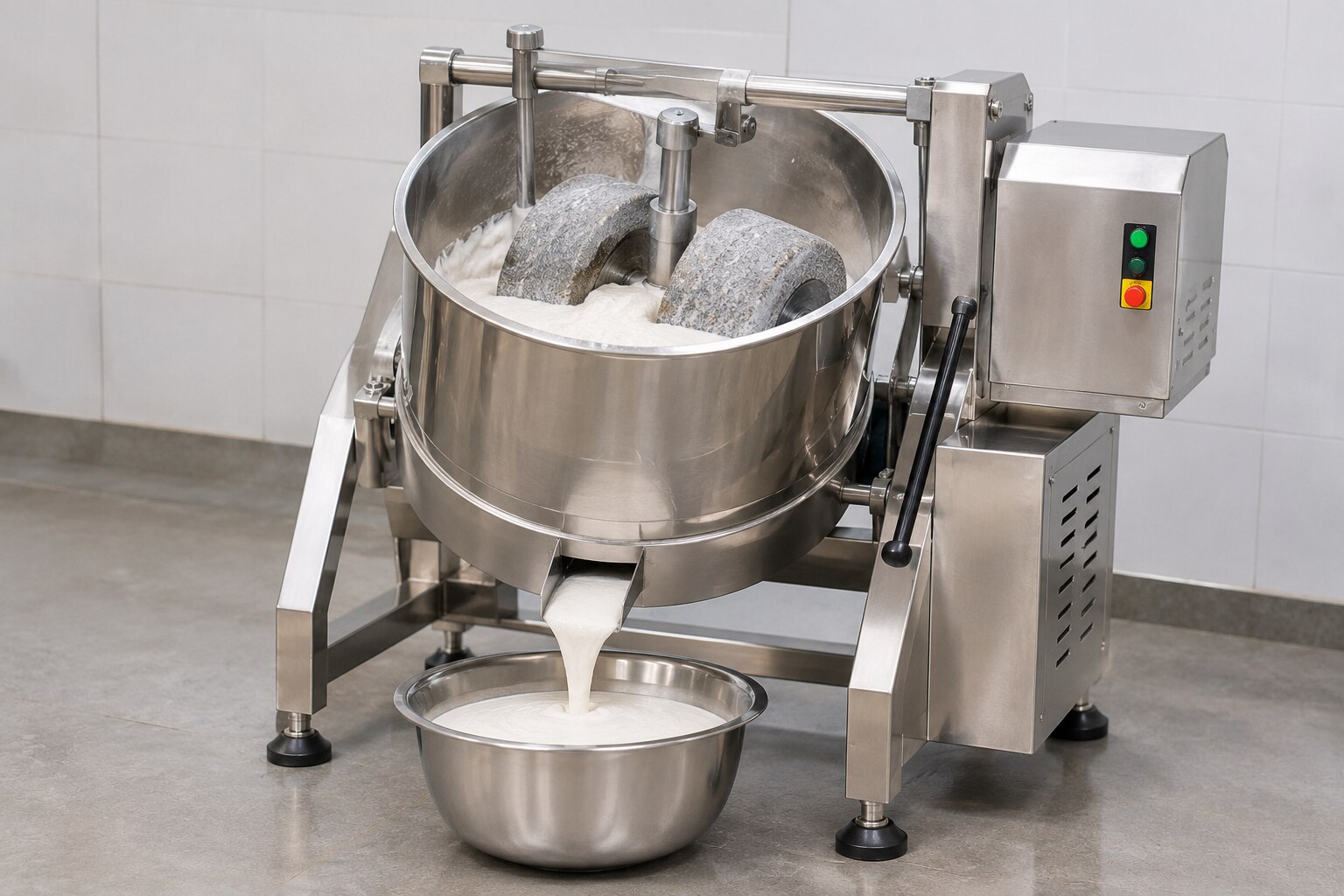
A grinder that stops under load can be suffering from process overload, voltage loss, belt slip or mechanical binding, and each fault needs a different response. By the end, you will have a safe restart method, a loading routine, site checks for Coimbatore conditions and a maintenance record that helps prevent repeated stoppages.
Key takeaways
- Classify the trip before resetting the motor starter.
- Reduce batch load when the grinding mass forms a heavy, immobile plug.
- Check phase loss, low voltage and loose starter connections at the machine.
- Inspect belts, bearings and grinding stones before production resumes.
Classify the Stall Before You Reset the Starter
A stoppage is not automatically an overload. Classify it before resetting the starter: an overload trip, supply fault, slipping drive and seized grinding assembly need different repairs, and raising the overload-relay setting can burn the motor.
1. Isolate the machine and record whether the overload relay, short-circuit protection or thermal protection operated. If the motor hums, stops under a thick batch and draws high, balanced current, suspect process overload.
A 50 litre wet grinder stalling problem often starts with too many soaked ingredients and too little water before the stones establish a running film.
2. Check line voltage and current on all phases during a representative load. One low phase current, a missing phase, unequal currents or a loose, hot terminal points to a supply fault. Do not keep resetting a 60 litre wet grinder that trips immediately or trips again after its motor cools.
3. With power isolated, inspect the belt, pulley and coupling. A motor that runs while the drum or stones slow down indicates belt or coupling slip, not an electrical trip.
4. Turn the grinding assembly only as the manufacturer permits. Hard resistance, scraping, stone misalignment, a seized bearing or a damaged seal indicates mechanical binding; isolate the grinder and arrange service.
For a commercial wet grinder breakdown in coimbatore, record the recipe, batch weight, water quantity, fill level, start and stop times, phase currents, line voltage, relay indication, motor temperature and belt condition. Note whether the failure repeats only at full load.
This record separates repeatable overload from intermittent electrical faults and makes a service visit more productive. It also helps identify heat, dust or wash-down moisture affecting a large tilting wet grinder stalling in coimbatore.
Load the Drum Without Creating a Process Overload
Keep the first charge small enough for the stones or rotor to establish a running film before thick batter reaches the working zone. A full drum is not required to overload a 50-litre or larger grinder; low water, coarse particles, cold ingredients and a high soaked-grain ratio can raise torque sharply.
1. Check the machine maker’s capacity in kilograms per batch, not only drum volume. Weigh the soaked ingredients and record the intended water quantity before loading.
2. Add water first, then introduce a small portion of soaked grain or other solids. Start the grinder and let the assembly reach normal speed before adding more material.
3. Feed the remaining solids in controlled portions. Wait for each portion to circulate instead of tipping the entire batch into one compact mass.
4. Keep enough water for the stones to turn freely and maintain circulation. If the mixture forms a stationary plug, stop feeding and dilute it according to the recipe; do not push the mass down by hand or with a tool.
5. Record batch weight, water quantity, starting time and grinding time. If the same batch runs normally after dilution, the 50 litre wet grinder stalling problem points to process overload rather than proof of a failed motor.
Never cure repeated trips by increasing the overload-relay setting. Stop loading and isolate the grinder if it stalls with a small charge, runs unevenly when empty, or trips again after the batter is corrected.
Check Voltage, Phases and Starters at the Coimbatore Site
Low voltage, phase loss, current imbalance and overheated starter components all reduce motor torque or trip protection. Diagnosing large tilting wet grinder stalling in Coimbatore starts at the motor terminals, not only the incoming panel: measure line voltage and current on all phases while the drum carries a representative batch.
| Condition | What you will see | Correct response |
|---|---|---|
| Voltage sag | Motor slows, current rises, and the overload relay trips during mixing | Measure voltage at the motor terminals during the event; inspect cable size, joints and supply capacity |
| Phase loss or imbalance | One phase carries abnormal current, the motor hums, heats rapidly or loses torque | Stop the machine and check fuses, contactor poles, terminals and phase continuity |
| Starter or connection fault | A burnt contactor pole, loose lug or corroded terminal causes intermittent trips and heat | Isolate power, tighten or replace damaged connections, then test insulation and earth continuity |
A 60 litre wet grinder stops during use for an electrical reason only after you rule out a thick batter that raises torque. Record the batch, water quantity, starting time, stopping time, motor temperature, overload indication, and current on each phase.
- Inspect cooling passages for flour and dust; a hot motor trips sooner.
- Keep wash-down water away from the starter and terminals. Moisture causes leakage and corrosion.
- Check that the overload relay and short-circuit protection match the motor and starter.
- Do not increase the overload setting to keep production running. Repeated trips require isolation and testing.
Find Belt, Bearing and Stone Problems Before They Stop Production
A belt that slips, a bearing that runs hot, or a stone rubbing the vessel can turn normal load into a stalled drive. Inspect these parts at scheduled production intervals, not only after a commercial wet grinder breakdown in Coimbatore.
1. Isolate power, lock out the starter, and turn the stone assembly by hand. Resistance, scraping or a tight spot points to a rubbing stone, product beneath the scraper, a swollen seal, foreign material, misaligned coupling or failing bearing. Do not reset the starter until you find the drag.
2. Inspect the belt for glazing, cracks, oil contamination and rubber dust. Check tension, pulley alignment, pulley grooves, belt profile and guard clearance together. Set tension to the transmission maker’s specification; overtightening increases bearing load instead of restoring torque.
3. Check bearing housings and seals for heat, noise, leakage and shaft play. Lubricate only bearings specified for lubrication, using the stated grease and quantity. Excess grease creates heat, while a damaged seal can introduce wash water and contaminate the bearing.
4. Under a representative batch load, compare current on all phases and record motor temperature. Tighten terminals, inspect insulation, test earth continuity, and use a thermal camera or contact thermometer to find hot connections. Check dust-blocked cooling passages, moisture ingress and corrosion after wash-down.
5. Confirm the overload relay and short-circuit protection match the motor and starter ratings. Never raise the overload setting to keep production moving. SAHITH ENGINEERING can use these records to distinguish a transmission problem from a machine-selection or operating issue: recipe, water quantity, batch state, phase currents, line voltage, trip indication, temperature and belt condition.
Related product
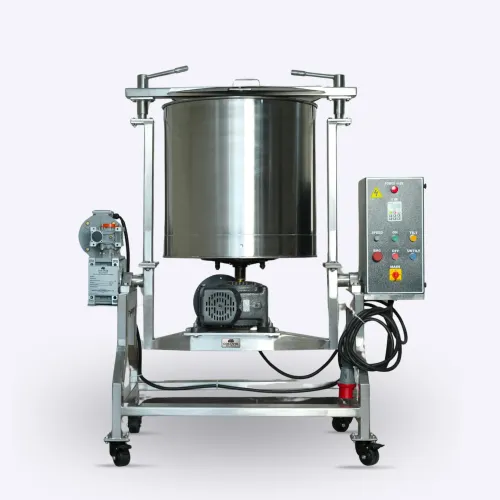
 | Commercial Tilting Wet Grinder Sahith 50 Liter Tilting Wet Grinder – Commercial Wet Grinder Machine 🔹 50 Litre Tilting Wet Grinder Manufacturer in Coimbatore We are a leading manufacturer and supplier of 50 litre tilting wet grinder machines in... View product → |
Use a Safe Restart and Fault Record After Every Stall
Do not press reset repeatedly after a trip. If a 60 litre wet grinder stops during use, stop feeding material, isolate the electrical supply, and keep hands clear of the drum and stones.
- Read the overload relay or starter indication before resetting anything.
- Wait for the relay and motor to cool according to the manufacturer’s procedure; do not bypass the relay or contactor interlock.
- Remove or safely relieve the load only as the machine instructions permit.
- Check that the drum and grinding assembly rotate freely before restarting with a small water charge.
Record the following for every trip:
- Batch recipe, ingredient weight, soaked-grain ratio, and water quantity
- Whether the drum was empty, partly loaded, or full
- Start time, trip time, and grinding duration
- Motor current on each phase and line voltage during the event
- Overload-relay indication and motor temperature
- Belt, coupling, bearing, seal, and stone condition
- Ambient heat, dust around cooling passages, wash-down moisture, or loose terminals
A repeated trip with similar recipes, rising current on all phases, and normal voltage points to process overload. For a 50 litre wet grinder stalling problem, a batch that runs after dilution supports that conclusion.
A trip at low load, unequal phase current, voltage loss, burning connections, belt slip, bearing drag, or stone misalignment indicates an electrical or mechanical fault. Give the complete record to the technician instead of reporting only that the grinder stopped.
Frequently asked questions
What should you check before resetting a stalled wet grinder?
Identify whether the stoppage came from an overload trip, supply fault, slipping drive or seized grinding assembly. Do not increase the overload-relay setting before finding the cause.
Why does a 50-litre wet grinder stall during use?
A 50-litre grinder can stall when the batch is loaded too quickly, the grinding mass becomes too dense, or worn stones, belts or bearings increase resistance.
What electrical faults can stop a 60-litre wet grinder?
Check for phase loss, low or unbalanced voltage, loose terminals and a faulty motor starter. Isolate power before opening the starter or control panel.
What should you record after a commercial wet grinder breakdown?
Record the time, batch size, material condition, motor current, phase voltages, trip indication and inspection findings before restarting production.
Keywords