A 20-litre bowl does not give you 20 litres of usable batter, paste or chutney in every recipe. You will be able to judge the purchase by converting demand into usable batch size, complete cycle time, labour savings, installation requirements and the cost of choosing a smaller or larger machine.
Key takeaways
- A 20-litre bowl does not equal 20 litres of usable batter.
- Choose capacity from your smallest profitable batch, not your largest order.
- Tilting pays when manual scraping, lifting and transfer slow production.
- Confirm power supply, materials, warranty and test-batch terms before ordering.
What Can You Actually Grind in a 20-Litre Bowl?
A 20-litre bowl does not produce 20 litres of batter or paste. Usable capacity depends on headspace, water ratio, particle size and the manufacturer’s minimum and maximum batch limits.
Ask the supplier to grind your recipe at the intended batch size; a machine that accepts 20 litres of water may not safely handle 20 litres of soaked grain or thick paste.
| Preparation | Fit for a 20-litre bowl | Capacity check |
|---|---|---|
| Idli or dosa batter | Strong fit for repeat wet batches | Leave room for swelling, water and mixing |
| Masala, ginger-garlic or chutney paste | Fit, including thick mixtures | Confirm the stones do not stall at peak thickness |
| Coconut-based products | Fit when scraped and discharged cleanly | Check retention around the rim and shaft seal |
| Thin sauces or wet fillings | Fit, but avoid underloading | Confirm the minimum batch size |
| Stiff dough | Poor fit | Use a dough mixer for folding and kneading |
For a tilting wet grinder for food business, cleaning time is part of capacity. Product trapped behind scrapers, beneath the bowl rim or in the discharge path reduces yield and creates cross-contact risk. Time a strip-down and wash using the real product, then check whether routine cleaning needs tools.
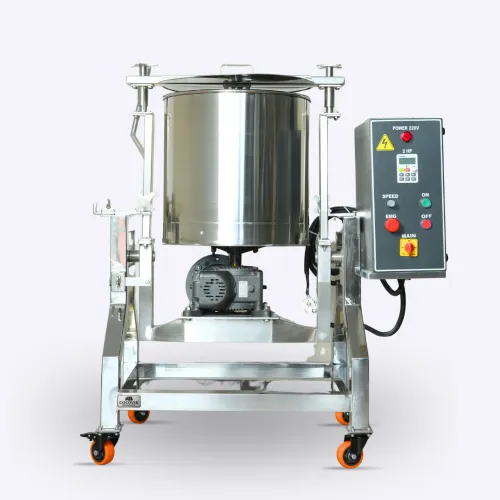
If you are comparing a 20 litre tilting wet for grinder in coimbatore, match its usable batch to your daily demand and cycle time. It suits businesses running repeatable batter, paste or chutney batches; it is a poor choice for scattered small batches or one machine expected to grind, refine chocolate and mix dough.
When Does Tilting Pay for Itself?
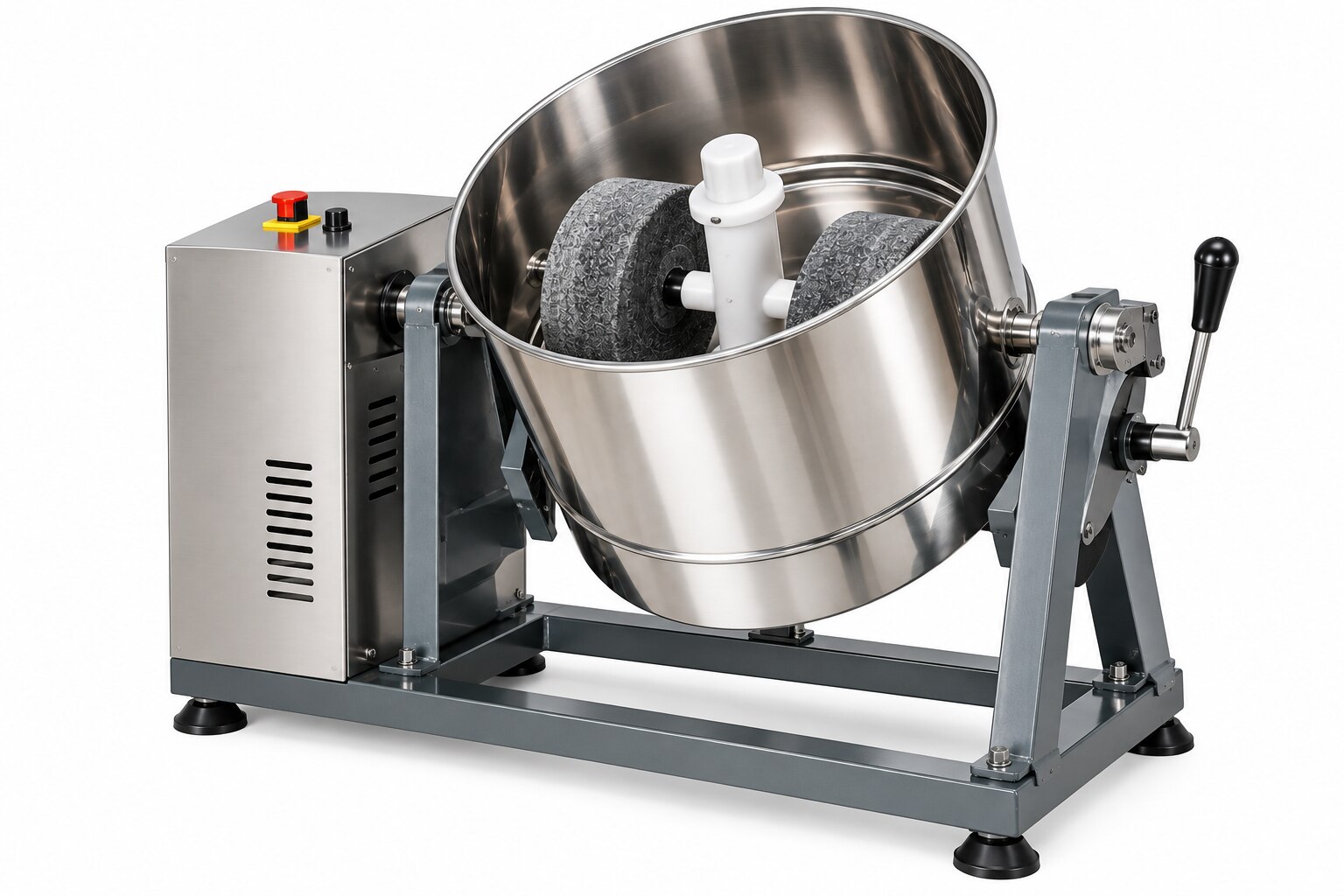
A 20-litre tilting grinder pays for itself when you can fill its usable capacity repeatedly, complete enough batches each day, and save measurable labour or product during discharge. The bowl’s 20-litre rating is not 20 litres of finished batter: water ratio, particle size, headspace and the supplier’s minimum batch limit determine the real output.
Calculate your likely return using this sequence:
- Record the saleable kilograms or litres from one demonstrated batch, not the vessel volume.
- Multiply that output by the batches you can complete during the busiest production period.
- Time one complete cycle: loading, grinding, unloading, washing and any soaking or preconditioning.
- Compare the tilting unit with your current method for labour minutes, transfer containers, spillage and retained product.
- Divide the installed price by monthly savings from labour and recovered product, then add electricity, maintenance and replacement parts to the cost.
A tilting wet grinder for food business becomes commercially useful when unloading no longer requires scooping a heavy paste from a fixed bowl or lifting it into another vessel. The gain is reduced handling, not automatically more hourly production; overheating, slow cleaning or long soaking can still limit batches.
Do not buy it for occasional small batches, frequent recipe changes or as a substitute for a dough mixer. A stiff dough can overload the drive and develop uneven gluten.
Before ordering, run your recipe at the intended batch size and time the wash-down; difficult access around the rim, shaft seal, scrapers or discharge path can erase the labour saving.
How Should You Choose Between 10, 15, 20, 30 and 50 Litres?
Choose the size from your busiest production hour, not your average daily total. Calculate required usable batch volume as peak-hour demand multiplied by complete cycle time in hours, including loading, grinding, discharge and wash-down. Select the next size above that figure, while leaving headspace for water, expansion and safe mixing.
| Option | What it means | When it applies |
|---|---|---|
| 10 litres | Smallest footprint and lowest batch commitment | Choose for modest demand, frequent recipe changes or limited floor space. |
| 15 litres | A middle step with more usable capacity | Choose when 10 litres forces an extra peak-hour batch but 20 litres would sit idle. |
| 20 litres | A practical commercial compromise | Choose when repeatable wet-grinding demand supports regular batches and tilting reduces handling or spillage. |
| 30 litres | Higher peak-hour output, with greater space and supply needs | Choose when smaller machines create queues or overtime during busy periods. |
| 50 litres | Large-batch production and substantial installation demand | Choose only when demand, floor space, cleaning capacity and electrical supply justify it. |
A 20-litre bowl does not mean a 20-litre working batch. Ask for the manufacturer’s minimum and maximum usable load using your recipe. That is the practical test for a 20 litre wet grinder in tamil nadu: confirm the nameplate supply, phase, cable, protective device, earthing and starting current before purchase.
Compare the machine with equipment you already own. A wet grinder is not a dough mixer, chocolate refiner or conche; buying excess capacity for those jobs can leave an expensive bowl underused.
What Must You Confirm Before Ordering in Coimbatore?
Do not compare quotations until each supplier states the machine’s usable batch range, not only “20 litres”. Ask for a demonstration with your recipe, because water ratio, particle size and bowl geometry determine whether the batch actually fits.
| Category | Obtain in writing | Why it matters |
|---|---|---|
| Technical | Motor rating, permitted duty cycle, starting current, speed, torque, stone diameter, transmission, overload protection, shaft-seal design and bearing access | Equal motor ratings can produce different output, heat and service costs |
| Electrical | Single-phase or three-phase supply, voltage, cable size, breaker or protective device, earthing requirement and starting current | A 20 litre wet grinder in Tamil Nadu is useless if your premises cannot start it reliably |
| Installation | Overall dimensions, operating clearance, machine weight, floor requirements, drainage, delivery method and installation responsibility | Tilting needs space to discharge safely without striking walls, drains or staff |
| Food contact | Grade and finish of bowl, shaft, scrapers, fasteners, seals, stone binder, coatings, lubricant and cleaning-chemical compatibility | “Stainless steel” does not cover every product-contact component |
| Service | Local response time, technician attendance, stocked seals, stones, belts, bearings, overload parts and switches; warranty coverage for labour, wear parts and electrical damage | Exclusions for stones, seals, overload and voltage faults can erase a cheap quotation |
For a commercial wet grinder in Coimbatore, record cleaning time in the quotation review: product must not remain under the rim, around the shaft seal or behind scrapers. Ask SAHITH ENGINEERING to state these terms on the quotation, then compare total downtime—not just the purchase price.
Related products
 | Commercial Tilting Wet Grinder Commercial Tilting Wet Grinder 20 Litres – Wet Grinder Machine 20 Litre Tilting Wet Grinder Manufacturer in Coimbatore We are a leading manufacturer and supplier of commercial tilting wet grinder machines in... View product → |
 | Tilting Wet Grinder Tilting Wet Grinder Mnufacturers 🔹 Tilting Wet Grinder 20 Litres – Commercial Wet Grinder Machine We are a leading manufacturer and supplier of tilting wet grinder machines in... View product → |
How Do You Test Whether the Machine Fits Your Process?
A machine fits your process only when it handles your actual recipe, cleans within your production schedule and delivers measurable quality—not when its 20-litre label looks attractive.
1. Take your ingredients and recipe to the demonstration. Run the intended batch size, including the same water ratio, particle size and thick or thin consistency. Record loading time, grinding time, usable output, motor overloads, vibration and the quantity left behind. A 20-litre bowl is not a 20-litre working load.
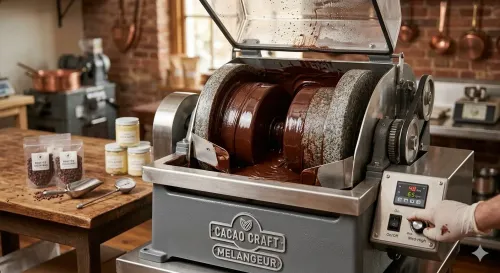
2. Weigh the product before and after grinding. Check batter or paste consistency, separation after standing and the time needed to reach your acceptance standard. For cocoa or chocolate work, measure particle-size distribution and temperature rise; visual smoothness does not prove low-micrometre refinement. Confirm residence time and performance with fat-rich, low-free-water masses.
3. Run a timed strip-down and wash using the real product. Inspect under the bowl rim, around the shaft seal, behind scrapers and through the discharge path. Record retained product, dismantling time, water use and reassembly time. Reject a design that needs tools for routine food-contact cleaning unless your sanitation procedure supports that delay.
4. Check the bowl, shaft, scrapers, fasteners, seals, coatings and stone binder individually for food-contact suitability. Then start the machine on your premises and verify the nameplate supply, starting current, overload protection, earthing and duty cycle.
A commercial wet grinder in Coimbatore that cannot start reliably is not an upgrade, while a tilting wet grinder for food business that passes these tests has earned consideration.
Frequently asked questions
What can you grind in a 20-litre wet grinder?
You can assess it for products such as batter, chutney, spice pastes and other wet mixtures, but confirm the machine’s particle-size limits, water ratio and minimum batch size for your recipe.
When does a tilting wet grinder pay for itself?
Tilting becomes valuable when transferring heavy batter or paste takes repeated lifting, scraping or worker time. Compare that saved labour and handling time with the machine’s purchase and operating costs.
How should you choose between 10, 15, 20, 30 and 50 litres?
Base the choice on usable batch volume, not bowl size. Match the smallest regular batch to the manufacturer’s minimum and leave headspace for safe, consistent grinding.
What must you confirm before ordering a wet grinder in Coimbatore?
Confirm the electrical phase and power requirement, bowl and contact-part material, usable capacity, minimum batch size, discharge method, cleaning access, warranty and local service arrangements.
How do you test whether the machine fits your process?
Run your actual ingredients and recipe at the intended batch size. Check grinding time, final texture, temperature rise, discharge time, cleaning effort and whether any paste remains trapped in the bowl.
Keywords