A quoted capacity such as 500 kg/h does not tell you how many kilograms of clean nibs the machine will deliver. By the end, you will know which feed conditions, separation results, electrical details, construction features, trial records and quotation line items to demand before approving a purchase.
Key takeaways
- Define capacity using bean moisture, roast level, size and temperature.
- Request crack-size results, nib recovery and winnowing performance from a sample trial.
- Check motor power, compressed-air needs, dimensions and food-contact materials.
- Demand an itemised quotation covering installation, spares, warranty and maintenance.
Define Capacity by Bean Condition, Not by a Headline Kilograms-per-Hour Figure
A 500 kg/h rating is meaningless until you know what enters the machine. A cocoa bean cracker machine in Coimbatore may achieve that figure with cooled, properly roasted whole beans, yet struggle with damp, under-roasted beans. Ask whether the rating refers to whole beans, nibs, raw beans, or another feed.
Before comparing cocoa bean cracker machine specifications, document these conditions:
1. Record the feed basis: raw or roasted beans, whole-bean moisture range, roast level, cooling time after roasting, bean-size distribution, and maximum foreign-matter content. Confirm whether cleaning must remove stones, metal, dust and other material before cracking.
2. Request capacity in kilograms per hour for your actual feed, not only the supplier’s standard test material. Raw beans are tougher and more elastic than conditioned roasted beans, so a roasted-bean rating cannot size a raw-bean cracking stage.
3. Make the acceptance test report feed rate, whole beans remaining, shell carryover in the nib fraction, nib loss in the shell fraction, excess fines and power consumption. A machine that reaches its headline rate by producing broken shells and fines is not delivering equivalent capacity.
4. Separate feed throughput from saleable nib throughput. A cracker is one stage in a line, so confirm whether the stated rate includes the feeder, elevator, winnower, cyclone, dust filter and controls, or describes only the cracker.
Put every assumption in the quotation. Otherwise, two machines labelled 500 kg/h are not comparable.
Compare Crack Distribution, Nib Recovery and Winnowing Results
Judge a cracker and winnower by the mass balance of a defined trial, not by motor size or a 500 kg/h headline. A commercial cocoa cracker india quotation is useful only when it states whether that figure means whole-bean feed, usable nibs, or total discharge.
| Result to compare | Acceptable evidence | Warning sign |
|---|---|---|
| Crack distribution | Feed rate, bean condition, sieve method, usable nib percentage, whole beans remaining and excess fines reported separately | “Uniform cracking” with no percentages or sieve sizes |
| Winnowing selectivity | Shell carryover in the nib fraction and nib loss in the shell fraction, both measured by mass | Clean-looking nibs with no shell or nib loss figures |
| Dust and fines | Fines identified separately from saleable nibs, with dust collected at the stated airflow | High fan speed presented as proof of better separation |
| Energy use | Kilowatt-hours or motor power recorded at the tested feed rate | Motor rating used as a substitute for recovery data |
Require the sample report to name roast level, cooling time, moisture, bean-size range and foreign-matter content. Test the machine at your intended feed rate, then repeat with a husk-heavy or uneven batch; aggressive impact can create fines, while gentle cracking leaves whole beans and shell attached to nibs.
Ask for these machine settings and results in the cocoa cracker machine details:
- Rotor speed or roller gap, impact clearance, screen aperture and adjustable air volume.
- Whole beans remaining, nib loss to shells, shell carryover and fines as percentages of feed mass.
- Fan or blower power, discharge routes and the definition of “usable nib.”
- A retained sample from each fraction, so you can inspect shell fragments and unbroken beans rather than trust a brochure.
Check Power, Airflow, Dimensions and Food-Contact Construction
Get the quotation to state every connection, clearance and contact material before you reserve floor space for a cocoa bean cracker machine in Coimbatore. A headline motor rating is not enough: an undersized electrical supply, inaccessible service door or poorly specified winnowing fan can stop commissioning.
| Item | State in the quotation | Why it matters |
|---|---|---|
| Electrical power | Voltage, phase, frequency, connected load, individual motor kW, control-panel rating and starting current | Confirms your plant supply can start the machine without nuisance trips |
| Air handling | Blower or fan kW, airflow in m³/h, static pressure, duct diameter, adjustable damper, cyclone and filter connections | Prevents weak shell separation and uncontrolled cocoa dust |
| Installation footprint | Overall length, width and height, operating clearance, floor loading, inlet and discharge heights | Shows whether the line fits and whether operators can reach drives and clean-outs |
| Access and lifting | Door width, machine weight, lifting points, removable panels and maintenance-side clearance | Avoids discovering that the machine cannot enter or be serviced |
| Food-contact construction | SS304 or specified equivalent, weld finish, screen metal, gasket material and clean-out design | “Stainless-steel machine” does not prove every product-contact part is stainless |
Ask the cocoa bean processing machine supplier to separate the base cracker, feeder, elevator, winnower, blower, cyclone, dust filter, control panel, platform, freight, installation, commissioning and training. Require product-contact surfaces to be distinct from a painted or mild-steel frame, with removable screens and sealed access doors identified individually.
Use a Written Sample Trial and an Itemised Purchase Quotation
Require a signed sample-trial report and an itemised quotation before approving a cocoa cracker machine for machine specifications in Coimbatore. A “500 kg/h” claim is not acceptance evidence unless the supplier identifies the feed and reports saleable separation results.
1. Send a representative batch and record whole-bean moisture, roast level, cooling time, bean-size range and foreign-matter content. Ask the supplier to state whether the trial uses raw or roasted beans; raw beans are tougher and more elastic, so roasted-feed results cannot size a raw-bean stage.
2. Require measured results at the agreed feed rate: percentage of whole beans remaining, shell carryover in the nib fraction, nib loss in the shell fraction, excess fines and electrical power consumption. Include photographs or weighed samples from the nib and shell outlets, then write acceptable limits into the purchase order.
3. Request cocoa cracker machine details covering the cracking adjustment, winnower airflow, fan rating, dust discharge and performance on uneven batches. Make the supplier repeat the trial if the agreed limits are missed, with the remedy stated in writing.
4. Demand separate prices for the base cracker, feeder, elevator, winnower, cyclone, dust filter, control panel, platform, installation, commissioning, freight, taxes and operator training. SAHITH ENGINEERING, like any local supplier, should also state warranty duration, delivery scope and payment milestones rather than leaving these items to verbal discussions.
Related products
 | Cocoa Bean Winnower Machine 🔹 Cocoa Bean Cracker Machine – Industrial Cocoa Processing Machine We are a leading manufacturer and supplier of cocoa bean cracker machines in... View product → |
 | Cocoa Bean Winnower Machine Automatic Cocoa Bean Cracker Machine 🔹 Automatic Cocoa Bean Cracker Machine – Industrial Cocoa Processing Equipment We are a leading manufacturer and supplier of cocoa bean cracker... View product → |
Calculate Maintenance Cost and Fit the Cracker Into the Processing Line
A low purchase price becomes expensive when screens, impact bars, bearings, or seals need frequent replacement. Calculate annual maintenance from the supplier’s stated wear life, replacement price, labour time, and cleaning downtime—not from the motor rating.
- Screen and impact-part cost per replacement
- Expected operating hours before replacement
- Bearing protection from cocoa dust and access for inspection
- Availability and lead time of locally machined spares
- Time required to change screens without removing the whole machine
Ask a cocoa bean processing machine supplier to identify bearing types, lubrication points, dust seals, and the cost of a complete service kit. Reject vague claims such as “low maintenance” unless the quotation states parts and intervals. A non-standard imported bearing can stop production while a locally available equivalent keeps the line running.
Dust control must include an enclosed transfer path, adjustable suction, cyclone or filter capacity, sealed discharge, and cleaning access. Uncaptured shell dust contaminates the room, settles on bearings, and can carry shell into nibs.
Size the cracker from the roasting schedule and the grinding demand. If roasting supplies 600 kg of conditioned beans per hour, a cracker rated for 600 kg/h leaves no allowance for stoppage, uneven feeding, or winnowing losses.
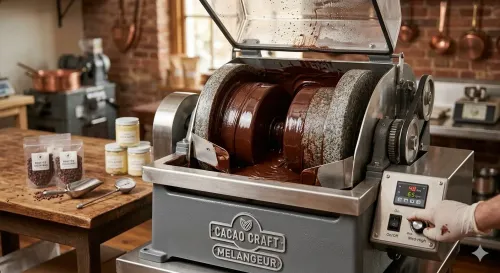
Excess shell reaching a wet grinder, colloid mill, or melanger changes texture, raises insoluble fibre, and can overload pumps.
For a commercial cocoa cracker in India, confirm local commissioning, troubleshooting response, operator training, and spare-stock location in writing. A quotation that omits the feeder, winnower, dust filter, controls, platform, installation, and freight understates the installed cost.
Frequently asked questions
Why is a cocoa cracker’s kilograms-per-hour rating not enough for comparison?
Capacity changes with bean condition. Ask whether the rating uses whole, cooled, properly roasted beans and record moisture, roast level, size and temperature.
Which performance results should you request from a cocoa bean cracker machine?
Request crack-size distribution, nib recovery, whole-bean carryover, shell separation and winnowing results from a representative sample trial.
What specifications matter besides throughput?
Check motor power, airflow or compressed-air demand, machine dimensions, access for cleaning, and the grade of stainless steel used on food-contact surfaces.
What should a purchase quotation for a commercial cocoa cracker include?
Ask for separate prices for the cracker, blower, cyclone, controls, installation, freight, taxes, commissioning, warranty, spare parts and operator training.
Related products
 | Cocoa Bean Winnower Machine Cocoa Beans Cracker and Winnower 🔹 Sahith Cocoa Beans Cracker & Winnower Machine We are a leading manufacturer and supplier of cocoa beans cracker and winnower machines in... View product → |
 | Cocoa Bean Winnower Machine COCOA BEAN CRACKER & WINNOWER MACHINE The Cocoa Bean Cracker & Winnower Machine is a vital piece of equipment in the chocolate production process, designed to efficiently break roasted... View product → |
Keywords