The right choice depends on more than the purchase price: roasted-bean throughput, raw-material variation, floor space, labour, dust control, and the level of independent adjustment you need. By comparing the process, output quality, specifications, and service requirements, you can decide whether one integrated line or two standalone machines fits your Tamil Nadu plant.
Key takeaways
- Define clean-nib recovery and husk carryover targets before comparing machines.
- Choose separate units when capacity growth, maintenance access, or product changeovers matter.
- Specify feeder, cracker, aspiration, conveyors, controls, and dust collection in the quotation.
- Run an acceptance test using your roasted beans at the promised feed rate.
Map the process from roasted bean to clean nib
The line must turn cooled roasted beans into two controlled streams: clean nibs for grinding and husk for disposal or recovery. Roasting comes first, followed by cooling, metered feeding, cracking, aspiration, nib collection, and husk discharge.
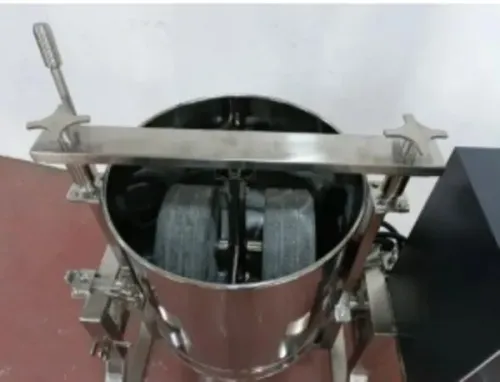
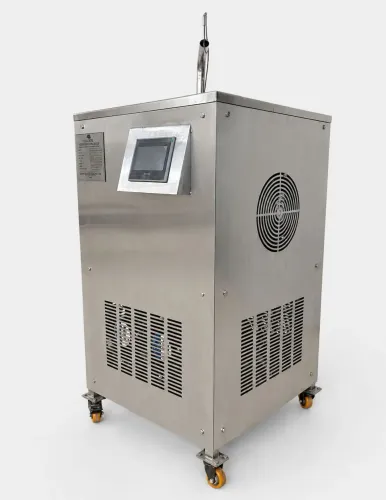
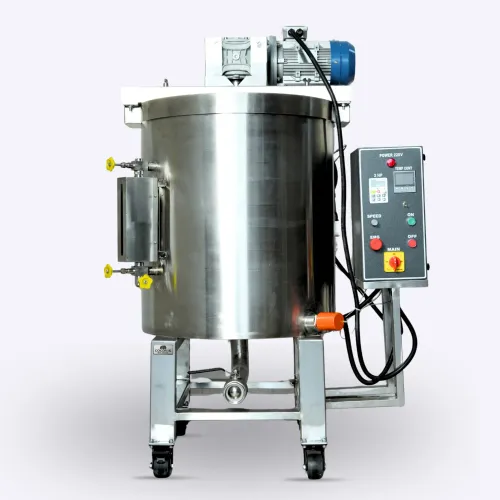
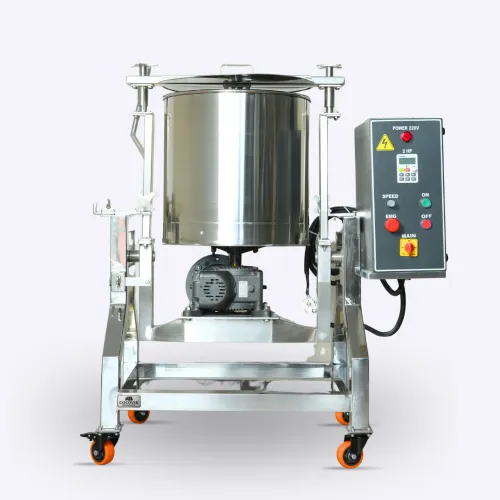
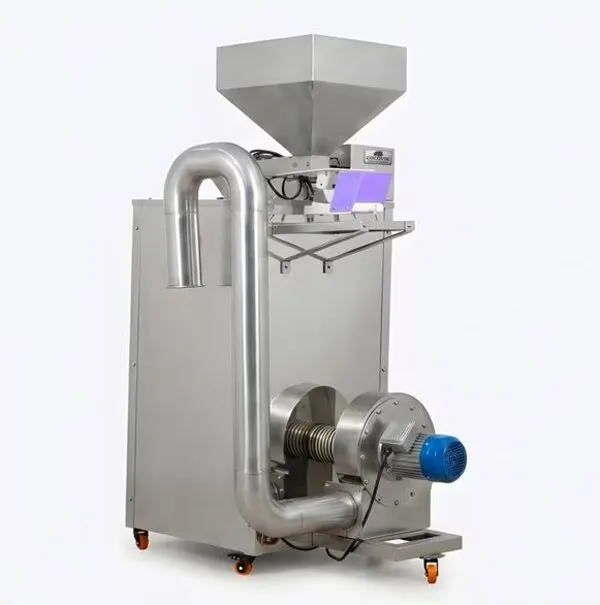
A cocoa bean cracker winnower in Tamil Nadu is normally a two-stage line in one frame; separate machines perform the same sequence with a transfer or surge hopper between them.
- Cool roasted beans fully before feeding. Hot beans distort airflow readings, soften handling surfaces, and can create condensation after aspiration.
- Feed a known rate. The cracker must break the bean without pulverising the nib, while the winnower must lift lighter shell away from heavier nib.
- Set breaker clearance or impact intensity, screens, and airflow for the actual bean-size distribution and roast profile. Large variation makes one setting leave whole beans while over-cracking small beans.
- Check moisture before trials and obtain the supplier’s allowable feed-moisture range. Wet beans separate poorly; over-dry or over-roasted beans create excessive fines, while under-roasted beans resist clean cracking and retain shell.
- Choose separate cracking and winnowing machines when you need independent adjustment, a buffer hopper, or the ability to service one stage while using the other. Choose the combined unit when compact flow and fewer transfers matter more.
Test either configuration on your own roasted beans, measuring clean-nib recovery, shell in the nib stream, nib loss in the shell stream, excessive fines, power consumption, and stable throughput. “95% separation” means little without the sampling method and measurement basis.
Compare cracking and winnowing performance, not machine labels
A usable comparison starts with the material leaving the line, not its name. Measure clean-nib throughput, shell carryover in nibs, nib loss in the shell discharge, uncracked beans, and fines. A machine that removes more shell but sends valuable nibs to waste is not performing better.
| Option | Measure | Combined line | Separate machines |
|---|---|---|---|
| Combined line | Clean-nib recovery | One trial result for the complete unit | Compare cracker output with winnower input and final nib output |
| Combined line | Shell in clean nib | Weigh shell from a retained nib sample | Test after cracking and again after aspiration |
| Combined line | Nib in shell discharge | Weigh recoverable nibs in the shell stream | Identify losses at each transfer point |
| Combined line | Capacity | Record usable nibs per hour | Record each machine’s rate, including transfer and handling time |
| Combined line | Fines and uncracked beans | Count fines and whole pieces in the final product | Adjust cracking separately before tuning air separation |
For a cocoa processing machine comparison in India, demand the same roasted-bean trial for both configurations. Retain labelled samples of feed, cracked material, clean nibs, shell discharge, and rejects; record batch mass, operating time, fan setting, and power use. A winnower cannot correct oversized fragments or excessive powder created by poor cracking.
Set an acceptance limit for shell carryover and nib loss before comparing prices. Repeat the test with the smallest and largest bean sizes you will process, because a setting that works for one roast or grade can produce reject-heavy output on another.
Choose the configuration from throughput, space, labour, and growth
Choose a combined unit when your batch size is modest, floor space is tight, and one operator must feed and collect product. Choose separate machines when throughput, recipe variation, or future expansion makes independent control more valuable than simplicity.
| Factor | Combined cracker-winnower | Separate cracker and winnower |
|---|---|---|
| Throughput | Suits a steady feed within one machine’s rated capacity | Suits higher or changing rates, with a surge hopper between stages |
| Space | Smaller footprint and fewer transfer points | Requires more floor space, conveyors, and collection points |
| Labour | Fewer feeding, handling, and transfer tasks | More monitoring, cleaning, and material movement |
| Growth | Expansion is limited by the integrated unit | Add capacity or upgrade one stage without replacing both |
For anyone comparing a cocoa bean cracker and winnower versus separate machines in Tamil Nadu, the key question is control. Separate equipment lets you adjust breaker clearance, screen selection, airflow, and feed rate independently when bean sizes or roast profiles change.
You can also bypass, clean, or service one stage while retaining limited use of the other.
Choose separate equipment if shell removal needs a different operating rate from cracking, or if production will grow in stages. Choose an integrated unit if avoiding conveyors, reducing dust transfer points, and saving labour matter more than maximum flexibility.
When assessing cocoa bean cracking equipment in Coimbatore, compare the supplier’s cocoa-specific results rather than relying on general food-machinery experience. Commercial grinding or dough-mixing capability does not prove that its breaker and aspiration system will handle your beans.
Specify the complete line and demand a meaningful acceptance test
Require a quotation for the complete installed line, not only a cracker or winnower. Specify feed hopper, magnet or foreign-body control, cracker, aspiration fan, cyclone or filter, nib and shell outlets, dust extraction, controls, cleaning access, wear-part access, motor ratings, airflow, noise, footprint, and electrical load.
Compare the two configurations against the same purchasing criteria:
| Configuration | Require from the supplier | Risk to check |
|---|---|---|
| Combined line | One rated throughput, one control system, shared fan and filter | A fault can stop both cracking and separation |
| Separate machines | Individual capacities, transfer arrangement, controls and extraction | Extra handling, space and labour can erase the price advantage |
Put these figures into the contract and test them on your roasted beans:
- Stable throughput in kilograms per hour, with beans fully cooled after roasting
- Clean-nib recovery, shell content in the nib stream, and nib loss in the shell stream
- Excessive fines percentage, with the sieve size stated
- Bean moisture and size range accepted by the machine
- Connected load, measured power consumption, airflow, filter area, dust discharge method, and noise level
Define the sampling method: weigh each output, take samples across at least three steady-state runs, and report the average and run-to-run range. Reject vague claims such as “95% separation” unless the denominator and sampling basis are written down.
During a cocoa processing machine comparison, India buyers should ask whether the test used their beans, not demonstration material. A cocoa winnowing machine supplier such as SAHITH ENGINEERING should also identify which settings and wear parts produced the result.
Related products
 | Cocoa Bean Winnower Machine Cocoa Beans Cracker and Winnower 🔹 Sahith Cocoa Beans Cracker & Winnower Machine We are a leading manufacturer and supplier of cocoa beans cracker and winnower machines in... View product → |
 | Cocoa Bean Winnower Machine 🔹 Cocoa Bean Cracker Machine – Industrial Cocoa Processing Machine We are a leading manufacturer and supplier of cocoa bean cracker machines in... View product → |
Compare cleaning, changeover, faults, and installed operating effort
An integrated cocoa bean cracker winnower in Tamil Nadu usually cleans faster because beans move directly from cracking to aspiration, with fewer transfer points and less handling labour. Separate machines take longer to clean, but a surge hopper lets you stop, bypass, or service one stage without shutting down the entire line.
| Option | After installation | Main trade-off |
|---|---|---|
| Integrated cracker-winnower | One compact frame, one coordinated control sequence, and fewer contamination points. Clean the cracker, air chamber, fan path, and collection outlets as one system. | A fault in the cracker, fan, or controls can stop both operations; settings are less independent for changing bean sizes or roast profiles. |
| Separate cracker and winnower | Open each stage independently, isolate faults, and optimise cracking speed and aspiration separately. A buffer hopper supports staged cleaning and changeover. | More conveyors, seals, hoppers, motors, extraction connections, and sanitation points increase inspection and cleaning time. |
| Either configuration | Connect magnets, filters or cyclones, shell discharge, and dust extraction correctly. | An undersized dust system spreads fine shell dust, overloads filters, and raises housekeeping and maintenance effort. |
For expansion, separate cocoa bean cracking equipment in Coimbatore is easier to enlarge with a larger cracker, second winnower, or added surge capacity. An integrated unit saves floor space and operator time at stable throughput, but changing its capacity can mean replacing the combined machine.
Demand access panels, tool-free contact-part removal, spare wear parts, and a fault-isolation procedure before installation.
Frequently asked questions
What happens between roasted cocoa beans and clean nibs?
Cool the roasted beans, meter them into the cracker, separate the shells by aspiration, collect the nibs, and discharge the husk for disposal or recovery.
Is a cocoa bean cracker and winnower better than separate machines?
An integrated unit saves floor space and transfers, while separate cracking and winnowing machines offer more flexibility for capacity changes, maintenance, and process adjustment.
What should you compare besides the machine name?
Compare feed rate, crack quality, clean-nib recovery, husk carryover, dust control, changeover time, access for cleaning, labour, and installed operating effort.
How should you test a cocoa processing line before purchase?
Use your own cooled roasted beans and record feed rate, clean-nib recovery, husk carryover, cracked-bean losses, power use, dust leakage, and stoppages during a witnessed run.
Related products
 | Cocoa Bean Winnower Machine Automatic Cocoa Bean Cracker Machine 🔹 Automatic Cocoa Bean Cracker Machine – Industrial Cocoa Processing Equipment We are a leading manufacturer and supplier of cocoa bean cracker... View product → |
 | Cocoa Bean Winnower Machine COCOA BEAN CRACKER & WINNOWER MACHINE The Cocoa Bean Cracker & Winnower Machine is a vital piece of equipment in the chocolate production process, designed to efficiently break roasted... View product → |
Keywords